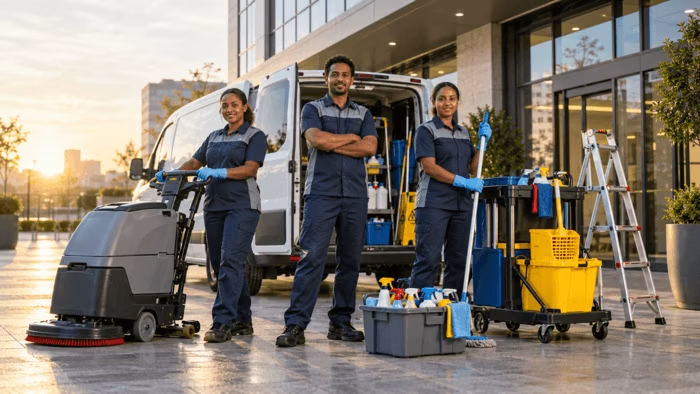
Recruiting fifteen commercial cleaners is not simply the same as hiring one cleaner fifteen times. A successful bulk order requires workforce planning, suitable skills, shift coordination, and a clear understanding of the facility's daily operations.
Facility management companies must consider more than headcount. Cleaning frequency, operating hours, equipment, site safety, and supervision all influence the type and number of workers required.
The most effective approach is to calculate the workload first, determine the workforce needed, and then prepare a recruitment request that reflects actual site requirements.
This guide explains how to plan a bulk cleaning staff order, estimate workforce numbers, organize candidate selection, and prepare teams for commercial facilities. It also highlights common mistakes that can cause understaffing, delays, or operational problems.
🏢 Why Is a Bulk Facility Cleaning Order Different From Household Recruitment
Commercial cleaning operations require consistent coverage across shared spaces, defined working schedules, and multiple cleaning responsibilities.
Unlike an individual household, a facility may need several workers performing different tasks simultaneously.
From Individual Tasks to Operational Coverage
A facility cleaning plan should focus on maintaining service throughout the operating day.
For example, an office complex may need routine cleaning before employees arrive, restroom maintenance during business hours, and additional cleaning after closing.
These tasks cannot always be handled efficiently by assigning workers without a clear schedule.
A structured approach to corporate and facility workforce placement considers the relationship between required headcount, work locations, and operational coverage.
The objective is to ensure that the appropriate workers are available when their services are needed.
Why Team Coordination Matters as Much as Individual Skills
Even experienced cleaners may struggle when responsibilities are poorly coordinated.
A team needs clear task assignments, reporting procedures, and supervision.
For larger facilities, workers may operate in separate cleaning zones or across different shifts.
Without proper coordination, some areas may receive unnecessary repeated cleaning while others remain unattended.
💡 Planning Tip: Define the cleaning operation before deciding how many workers to recruit. A clear operating plan makes workforce requirements easier to calculate.
📊 How Do You Calculate the Number of Cleaners Your Facility Needs
There is no single staffing ratio suitable for every commercial facility.
The required number of cleaners depends on the workload, cleaning methods, operating schedule, and expected service standards.
🔍 Start With Cleaning Areas and Required Frequency
Begin by dividing the facility into cleaning zones.
Common zones include:
✅ Offices and workstations.
✅ Corridors and shared areas.
✅ Restrooms and washing facilities.
✅ Entrances, reception areas, and elevators.
✅ Staff accommodation or communal spaces.
For each zone, estimate how often cleaning must occur and how long the tasks may take.
High-traffic areas may require attention several times daily. Other spaces may need scheduled cleaning outside business hours.
Equipment, surface type, accessibility, and hygiene requirements can also affect task duration.
Calculate Shift Coverage Without Understaffing
Once the daily cleaning workload is estimated, convert it into the number of worker-shifts required.
A simplified calculation is:
Daily cleaning hours ÷ Productive hours per cleaner = Required worker-shifts per day
Productive time should account for necessary breaks, movement between locations, equipment preparation, and other non-cleaning activities.
Next, calculate weekly coverage:
Daily worker-shifts × Operating days = Weekly worker-shifts
Divide that figure by the number of shifts each employee can legally and practically work.
Finally, review the result against actual shift schedules, rest requirements, and absence coverage.
🧮 Example: Planning a Cleaning Team for a Commercial Building
Consider a commercial property with an estimated requirement of 24 productive cleaning hours daily.
Assume each worker can complete six productive cleaning hours during an assigned shift, after allowing for breaks and other necessary activities.
| Planning factor | Illustrative requirement |
|---|---|
| Daily cleaning workload | 24 productive hours |
| Productive hours per worker-shift | 6 hours |
| Required worker-shifts daily | 4 |
| Operating days weekly | 6 |
| Total weekly worker-shifts | 24 |
| Planned shifts per worker weekly | 5 |
| Minimum calculated team | 5 workers |
The calculation produces 24 ÷ 5 = 4.8, rounded up to five workers.
However, five workers represent only the calculated baseline.
Actual staffing must also accommodate shift timing, weekly rest, approved leave, absences, and variations in workload.
🟠 Important: These figures are illustrative planning assumptions, not official staffing standards or recommended working-hour limits. Actual schedules must comply with destination-country employment rules.
📋 What Should a Bulk Cleaning Workforce Request Include

Once the staffing requirement is understood, it must be translated into a clear recruitment brief.
An incomplete request can result in unsuitable candidates, additional screening, or repeated changes.
Site Type, Shift Pattern, Headcount, and Work Conditions
A commercial cleaning request should identify the working environment and expected responsibilities.
An office tower, hotel, and residential compound may require different cleaning schedules and practical skills.
The request should also explain whether workers will remain at one site or move between approved locations.
For larger orders, bulk workforce supply arrangements depend on clearly defined worker quantities, occupational requirements, and agreed preparation expectations.
👥 Defining Team Leaders and Supervisors
Some facilities require workers who can coordinate tasks, monitor cleaning standards, and report problems.
These responsibilities should be identified before recruitment.
A supervisor should not automatically be counted as a full-time cleaner if supervisory duties reduce the time available for cleaning.
Similarly, an experienced worker should not be assigned supervisory responsibilities without confirming suitability.
✅ Bulk Cleaning Staff Order Checklist
Before submitting the request, confirm:
✅ Facility type and work locations.
✅ Required number of workers per site.
✅ Daily operating hours and shift patterns.
✅ Main cleaning responsibilities.
✅ Equipment and chemical-handling requirements.
✅ Language and communication needs.
✅ Team leader or supervisor requirements.
✅ Employment conditions and expected start dates.
🟢 Good Practice: Separate mandatory requirements from preferences. This makes candidate evaluation more consistent and avoids unnecessary restrictions.
🧹 What Skills and Safety Preparation Should Facility Cleaning Staff Have
Commercial cleaners may work with equipment, cleaning products, and procedures that differ from household routines.
Preparation should reflect the actual responsibilities of the position.
Commercial Equipment and Cleaning Techniques
Depending on the workplace, relevant skills may include operating floor-cleaning equipment, maintaining different surfaces, and following scheduled cleaning procedures.
Candidates should understand how to use equipment safely and recognize when additional instruction is required.
Reviewing facility cleaning staff skills helps define the practical abilities relevant to commercial worksites.
However, previous cleaning experience should not be treated as proof of competence with every machine or surface.
🛡️ Chemical Safety, PPE, and Site Procedures
Workers may need training in safe chemical use, correct dilution, storage instructions, and personal protective equipment.
Training should address the products and tasks the employee is authorized to perform.
Workers should also understand warning signs, restricted areas, and procedures for reporting hazards.
Specialized permits or certifications may apply to particular activities or locations. They should not be presented as universal requirements for every cleaner.
Communication and Team-Based Work
Cleaning teams need to understand instructions and communicate problems promptly.
Workers should know how to report equipment faults, spills, damaged surfaces, and unsafe conditions.
⚠️ Safety Note: General pre-departure training does not replace site-specific safety induction and equipment instruction after arrival.
👥 How Should Candidates Be Selected and Organized Into a Bulk Order
Recruiting a team requires more than approving candidates individually.
The group should collectively meet the operational requirements defined by the receiving partner.
Matching Workers to Different Site Responsibilities
Not every cleaner needs identical experience.
Some workers may focus on routine office cleaning. Others may have experience operating commercial equipment or maintaining high-traffic areas.
Candidate screening should therefore reflect the tasks assigned to each position.
Avoid requiring specialized skills from every candidate when only certain roles need them.
Balancing Team Experience and Supervisory Needs
A well-planned team may combine workers with different experience levels.
However, workers assigned leadership responsibilities should demonstrate appropriate communication and coordination abilities.
The balance should be established during selection rather than left entirely to the receiving facility.
Why Candidate Approval Does Not Mean the Entire Batch Is Ready
A worker may be approved for the position while still completing required documentation or travel procedures.
This becomes particularly important when several candidates belong to the same order.
For example, twelve candidates may be approved, but only eight may have completed all necessary pre-departure steps.
The order should therefore track individual readiness and overall batch completion separately.
📌 Key Point: Candidate approval, travel readiness, arrival, and starting work are different milestones.
📁 What Documentation Is Needed for a Bulk Cleaning Staff Order
Every worker must satisfy the applicable identity, employment, health, and travel requirements.
A bulk order adds the need to organize these records across multiple candidates.
Individual Candidate Files vs. a Batch-Level Manifest
An individual file contains documents relevant to one candidate.
A batch manifest provides an overview of the entire order.
The manifest helps recruitment partners identify completed stages and outstanding requirements without repeatedly reviewing every file.
📊 Example: Bulk Recruitment Tracking Sheet
| Candidate ID | Selection | Documentation | Travel readiness |
|---|---|---|---|
| C01 | Approved | Complete | Confirmed |
| C02 | Approved | Complete | Pending |
| C03 | Approved | Pending | Not confirmed |
| C04 | Under review | In progress | Not confirmed |
| C05 | Approved | Complete | Confirmed |
This table illustrates administrative tracking only. Actual readiness depends on the applicable official requirements.
Use unique candidate identifiers and provide access to personal records only to authorized personnel.
🇦🇪 Commercial vs. Domestic Recruitment Requirements in the UAE
The UAE provides an important example of why the legal employment category matters.
Commercial cleaners employed by private-sector companies are generally handled through the relevant private-sector employment and work-permit framework.
Domestic workers operate under a separate regulatory framework.
These categories should not be confused simply because both may involve cleaning duties.
When preparing UAE workforce recruitment requirements, the receiving partner should confirm the employer, permitted occupation, employment arrangement, and applicable authorization route.
🟠 Regulatory Note: The Ministry of Human Resources and Emiratisation administers relevant employment procedures. The correct permit route depends on the employment arrangement and applicable rules.
🚐 How Should a Large Cleaning Team Be Prepared for Arrival and Work
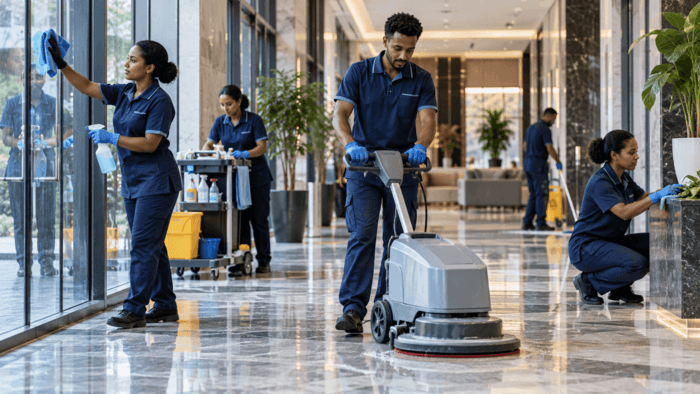
A completed recruitment order is only one part of operational planning.
Facility operators must also prepare for the arrival and integration of the workforce.
Planning Full-Batch vs. Phased Arrivals
Some operations may require the entire team to start together.
Others may be able to introduce workers in stages.
Phased arrivals can support gradual preparation where permitted, but the arrangement must be agreed upon and consistent with applicable employment procedures.
For example, a facility may prefer an initial group to complete site induction before another group arrives.
This should be planned rather than assumed.
🏢 Site Induction, Equipment Familiarization, and Initial Supervision
After arrival, workers may need orientation covering the facility layout, emergency procedures, equipment, reporting arrangements, and site-specific rules.
Pre-departure preparation and workplace induction serve different purposes.
Even experienced cleaners should receive instructions relevant to their assigned location.
Supervisors should confirm that workers understand their duties before independent work begins.
Maintaining Workforce Coverage After the Initial Start
Facilities should plan for authorized leave, absences, and changing operational requirements.
Possible measures include organized shift rotations, documented coverage arrangements, and lawful replacement procedures when appropriate.
Employment conditions, working hours, and rest requirements must remain consistent with applicable law and contracts.
🟢 Practical Tip: Treat workforce continuity as a scheduling responsibility, not simply a reason to recruit additional workers.
⚠️ Common Mistakes When Planning Bulk Commercial Cleaning Staff Orders
Several planning mistakes can create unnecessary costs or operational difficulties.
❌ Ordering Headcount Without Calculating Workload
Requesting a fixed number of cleaners without assessing the facility can lead to overstaffing or insufficient coverage.
✅ Better approach: Estimate cleaning tasks, productive hours, operating days, and shift requirements before calculating headcount.
❌ Ignoring Supervisory and Safety Requirements
A request may focus on the number of cleaners while overlooking team coordination, equipment familiarity, or site-specific safety needs.
✅ Better approach: Define supervisory duties and essential skills separately from general cleaning responsibilities.
❌ Treating All Candidates as Ready at the Same Time
Approving a group of candidates does not mean every worker has completed all required procedures.
✅ Better approach: Maintain individual progress records and a batch-level overview before confirming arrival arrangements.
Facility operators should also consider the broader six recruitment compliance checks when reviewing recruitment arrangements, employment documentation, and workforce preparation.
📌 Final Planning Reminder: A strong bulk order specifies the work, the people required, and the conditions needed for the team to operate safely and effectively.
Frequently Asked Questions About Bulk Commercial Cleaning Staff Orders
What information should a bulk commercial cleaning staff order contain?
A bulk order should specify the facility type, required headcount, shift arrangements, work locations, responsibilities, necessary skills, and expected start dates. It should also identify supervisory requirements and relevant employment conditions. Clear specifications help agencies select suitable candidates and prepare them for the intended positions.
How do facility operators estimate the number of cleaners required?
Start by calculating the daily cleaning workload. Divide the required productive cleaning hours by the realistic productive hours available per worker-shift. Then account for operating days, lawful shift patterns, rest periods, leave, and expected absences. The final number should be tested against the facility's actual schedule.
Should supervisors be included in the total cleaning staff headcount?
Supervisors should be identified separately when their responsibilities differ from routine cleaning work. If a supervisor also performs cleaning tasks, count only the realistic time available for those duties. This prevents staffing estimates from assuming that supervisory hours are fully available for cleaning.
Can a bulk cleaning team arrive in separate groups?
Phased arrivals may be possible when both parties agree and the applicable recruitment and immigration requirements allow them. Each candidate must still complete the necessary approvals and travel procedures. The receiving organization should coordinate arrival dates with its operational and onboarding plan.
Are commercial cleaning staff subject to the same recruitment rules as domestic workers?
Not necessarily. Employment rules depend on the destination country, employer, occupation, and employment arrangement. For example, the UAE distinguishes private-sector employment from domestic worker employment. Recruitment agencies should verify the correct legal category and permit requirements before processing an order.
Need Guidance on Your Facility Workforce Requirements?
Clear workforce planning helps commercial facilities organize recruitment and prepare cleaning teams for operational needs.
Adey Agency supports agency-to-agency Ethiopian workforce recruitment for overseas partners. To discuss commercial cleaning staff requirements or coordinated workforce orders, contact us about your facility workforce needs.